
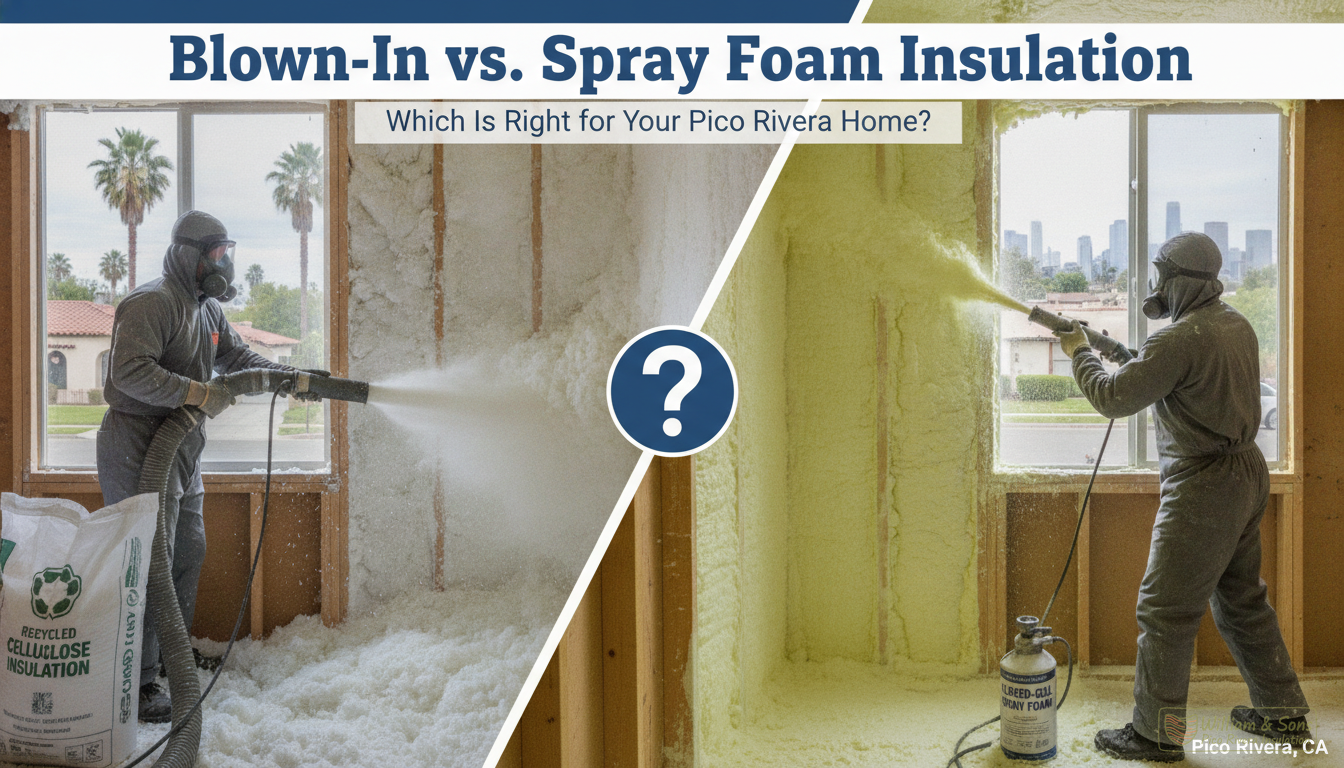
When Pico Rivera homeowners start researching insulation upgrades, one question comes up more than almost any other: Should I go with blown-in insulation or spray foam? Both are excellent products, both are installed by our team at William & Sons Pico Rivera Insulation, and both deliver real, measurable improvements in comfort and energy efficiency. But they work differently, cost differently, and excel in different applications. Here's everything you need to know to make the right decision for your home.
What Is Blown-In Insulation?
Blown-in insulation—also called loose-fill insulation—consists of small fibers or particles of fiberglass or cellulose that are mechanically blown into place using a large hose connected to a blowing machine. The material settles into a dense, even layer that conforms around obstructions, fills irregular framing bays, and covers the entire surface area without leaving gaps or voids. It's one of the fastest and most cost-effective ways to bring an under-insulated attic up to the R-38 to R-60 range recommended for Pico Rivera's Los Angeles climate zone.
Our blown-in insulation service uses professional-grade equipment to achieve consistent depth and density across the entire attic floor. Most jobs are completed in a few hours with no significant demolition required, making it a practical upgrade whether you're preparing your home for sale or simply want lower summer utility bills.
What Is Spray Foam Insulation?
Spray foam insulation is a two-component liquid that's mixed at the spray gun tip and applied to surfaces, where it expands and cures into a solid cellular foam. Unlike blown-in material, spray foam bonds directly to the surface it's applied to—creating a continuous air barrier and thermal layer in a single step. This is the key advantage that sets spray foam apart: it doesn't just slow heat transfer, it simultaneously stops air movement through the building assembly.
William & Sons offers both open-cell and closed-cell spray foam through our spray foam insulation service. Open-cell foam is lighter, more flexible, and ideal for interior walls and sound dampening. Closed-cell foam is denser, has a higher R-value per inch, and provides a moisture barrier—making it the preferred choice for crawl spaces, rim joists, and garage ceilings.
Head-to-Head: Performance Comparison
- R-value per inch: Blown-in fiberglass delivers approximately R-2.5 per inch; blown-in cellulose about R-3.5 per inch. Closed-cell spray foam delivers R-6 to R-7 per inch—nearly double to triple the thermal resistance in the same thickness. Open-cell spray foam provides about R-3.5 per inch.
- Air sealing: Blown-in insulation reduces but does not eliminate air movement. Spray foam expands into every crack and crevice, creating a true air barrier. This is why we always recommend pairing blown-in installation with dedicated air sealing for maximum performance.
- Moisture resistance: Blown-in cellulose can absorb moisture if exposed to leaks, potentially losing R-value and developing mold. Closed-cell spray foam is impermeable to water vapor and adds a secondary moisture barrier to any surface it covers.
- Settling over time: Properly installed blown-in insulation settles slightly after installation—which is why we install to a depth that accounts for expected settling and verify with depth gauges. Spray foam does not settle, compress, or shift after curing.
Which Applications Call for Blown-In?
Blown-in insulation is typically the right choice when:
- You need to increase attic floor R-value efficiently across a large area
- You're adding insulation on top of existing material that's still in good condition
- You have irregular joist spacing or obstructions that make batts impractical
- You're working with a budget and need the best cost-per-R-value ratio
- You want an eco-friendly option (blown-in cellulose is made from recycled paper products)
Learn more about how we handle attic-specific applications on our attic insulation installation page.
Which Applications Call for Spray Foam?
Spray foam is typically the superior choice when:
- You're insulating rim joists, sill plates, or band joists where air sealing and insulation need to happen simultaneously
- You're encapsulating a crawl space or sealing a vented attic roof deck (creating an unvented attic assembly)
- You're insulating a garage ceiling or other space where moisture exposure is a concern
- You want a permanent solution that will never sag, settle, or absorb moisture
- You're dealing with an irregularly shaped space where a continuous sealed envelope is the only practical option
See how spray foam pairs with our crawl space insulation service to deliver total building envelope protection from the foundation up.
Can You Use Both in the Same Home?
Absolutely—and many Pico Rivera homeowners do exactly that. A common whole-home approach is to use spray foam to seal and insulate rim joists and critical air leakage points, then use blown-in insulation across the attic floor to achieve the target R-value efficiently over a large area. This hybrid strategy captures the best of both worlds: the airtight performance of spray foam where it matters most, and the cost efficiency of blown-in for large-area coverage.
What About Removing Old Insulation First?
Before either product can perform at its best, your existing insulation may need to come out. If your attic has old, degraded, rodent-damaged, or moisture-soiled material, our insulation removal service extracts everything cleanly using commercial vacuum equipment before any new product goes in. This step is often skipped by homeowners looking to save money, but covering bad insulation with good insulation rarely delivers the results you're expecting.
Get a Free Assessment in Pico Rivera and Nearby Areas
William & Sons Pico Rivera Insulation serves homeowners throughout Pico Rivera and surrounding communities including Downey, Montebello, and Bell Gardens. We're open Monday through Sunday